Art Inspires Art – A Writer’s View

Waves Breaking by Claude Monet
I have found that visual art inspires my writing. How this works, I don’t know. But if I go to a museum and look at any kind of art or view someone’s photography (my own included), it can cause a thought process that inspires my creative side for writing.
For example, in November, I went to the Peabody Essex Museum in Peabody, Mass. and saw the exhibit Impressionists On The Water. This exhibit, which is on loan from the Fine Arts Museums of San Francisco, includes impressionistic works inspired by water. There are scenes of life by the sea or at the shores of a river. Lots of boats, lots of people, lots of water. It’s a wonderful exhibit.
The very last painting I saw as I left the exhibit is the one shown above – Waves Breaking by Claude Monet. I was stunned by the beauty of this painting. What struck me most is that the colors are so vibrant, as if the painting were completed just a week before it was hung. I marveled at it for some time. The painting is over 130 years old. And it looks as fresh and current as if it had been painted quite recently.
The description alongside this work said something to the effect that this painting showed that Monet was moving away from impressionism and toward abstract painting. This idea keeps coming back to me. And it makes me wonder if Monet had any sense of this as he painted it – that this painting would be seen as a turning point in his work. I find myself dwelling on this. I picture Monet working on this painting and wondering if he had any thought that he was in transition or would be perceived as having been in transition. Or was he so into his “zone” as he created this that how it would be received was not on his mind at all.
When I write, I don’t give thought to structure. I don’t think this is a good thing necessarily – in fact it could be a bad thing. But that’s just how it is for me when I write. I sit and write and before I know it I’m in another world, as if I’ve passed through a portal and I’m relaying in writing a story that exists and is being shown to me. While the story unfolds, I’m as surprised as the reader is later on when they read my books. I’m not thinking about the “archetype” of this character or that. I don’t think about the arc of the story. I don’t create a pivotal moment. I trust that those things will be there when the story is fully told, if I do a good job of it. Because, as far as I’m concerned, the people I am observing are real and the story is real so those things will be there, as they are in real life.
So, as I anticipate that a rush of writing is coming my way right now, I keep seeing this Monet painting in my mind. I think it’s an invitation to simply follow the creative energy and not worry about how the story will be received. Just put it to paper and let it be.
About Commercial Fiction
 Just after I posted about Poets & Writers magazine last week, I saw a post at Cristian Mihai‘s site (a blog I had just recently started to follow) that includes two short clips of an interview with David Foster Wallace – clips that focus on his thoughts on commercial fiction.
So, I’m sharing the link here to Critian Mihai’s post that includes the Wallace clips as a follow-up to the posts I wrote last week about Poets & Writers magazine – and commercially successful writing vs less commercially successful though more valuable literary writing.
I’ve written about David Foster Wallace here at sublimedays in the past, including posts I wrote both before and after reading the biography by D. T. Max about Wallace, titled Every Love Story Is A Ghost Story – A Life Of David Foster Wallace.
There are several long interviews with Wallace on the internet. As I watch them, I learn a great deal from his thoughts on contemporary writing – both about writing and about the culture in which we live.
A Poem About and Images of A Snowy Day

Snow Globe
by Mary McAvoy
The snow has returned as it always does.
This time, jumbo, nearly weightless flakes
add to its blanket on every up-facing surface.
A soundproof cover wraps the earth
and softens the vibrations of the world.
The silence is broken only by the
muffled rumble of accumulated snow tumbling off the roof.
Here inside my snow-globe
I pass the afternoon in a magical spell of wonder,
unmarred by age,
at nature’s ever-changing canvas.
Sunday’s Snapshots – a collection of images of Boston, Mass.

through Rowes Wharf Arch
I took the photos in this post in Boston, Mass. in early May, 2013. They were taken in and around the wharf area and financial district. I love architecture so you’ll see plenty of that, including one shot of the cavernous look of the financial district. The Customs House Tower is perhaps my favorite building in Boston’s skyline. You’ll see an image of old and new construction – where the rounded corners of an old building were mimicked in the nearby new building. And from an artistic point of view, I love to see the scraggly outline of the branches of a tree against the methodically planned grid of a tall building. Nature retains its way despite the feats of geometry and physics that mankind builds around it. If you click on any of the photos it will enlarge and you can scroll though all the images full-sized. Enjoy!


Saturday’s Song – A Thousand Years by Christina Perri
I’ve been listening to Pandora lately. The channel I started with has morphed into a great mix of really old stuff (1940s), oldies (60s & ’70s), and some great new stuff.
Of the new stuff, I have come to like the sound of Christina Perri, the song above in particular.
Here’s another of hers that caught my ear:
I prefer to listen to the songs without looking at the videos. I find them to be too distracting. So, maybe close your eyes and just listen!
Hope you like them!
PS I was a little disappointed to not have one “like” for the Amy Winehouse song, He Can Only Hold Her, that I posted last week. If you missed it, maybe have a listen now! The production is so ’60s – it has a fantastic sound.
Andre Dubus III and Elizabeth Gilbert On Writing
-
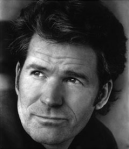
- Andre Dubus, III
-

- Elizabeth Gilbert
Every person who writes has a market niche. It might be small, it might be large. It might include intellectuals or it might be made up primarily of primary school children.
A niche will open for every writer who markets well. This has never been more true than it is today with traditional, independent and self publishing options.
Despite this, all writers become discouraged often, as they find their way in writing and in marketing. It’s the nature of the work. Discouragement comes when a writer is struggling over a story. Discouragement comes when a finished piece is (perhaps repeatedly) rejected by publishers.
Often, writers turn to other writers for tips on how to write better or to write well and on how to overcome the challenges of marketing.
Recently, I’ve seen two videos that have helped me in my own writing process. One is a 20 minute Ted Ed talk given by author Elizabeth Gilbert, which I came across through one of my favorite WordPress blogs, Lightning Droplets. Gilbert gives an intelligent and insightful talk that is of tremendous value. The other clip I found at Andre Dubus IIIs website. In it, Dubus addresses the influence of his father, an acclaimed writer, and what he calls the “ego-less-ness” that he ultimately achieved and how it freed him in his writing.
Here is the Dubus clip, which is a few minutes long:
And here is the Gilbert clip, which is about 20 minutes long:
The common theme in these clips is that, as a writer, you just have to show up and do the work and believe it’s what you are meant to be doing. I hope these help you in your writing journey.
More On Poets & Writers Magazine
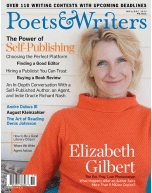
This post is further thought to yesterday’s post about the three magazines to which I subscribe. Specifically, it’s an example of what bothers me about Poets & Writers magazine.
Pictured above is the cover of the November/December 2013 issue of Poets & Writers. You see Elizabeth Gilbert is pictured on the cover as the feature. If it’s to small for you to see what it says under her name, it says, “The Eat, Pray, Love Phenomenon What happens After an Author Sells More Than 8 million Copies?”
In the space alongside Elizabeth’s picture is a list of other articles in this issue. The tenth line down says, “Andre Dubus III” – that’s it, no title to any of his books, no title to this particular article.
I’ve read books by Elizabeth Gilbert and I’ve read books by Andre Dubus, III. There is no doubt in my mind who is the better writer. Andre Dubus, III. Hands down. No questions asked. No arguments anticipated. Not even from Poets & Writers magazine. I’m not saying Gilbert is a bad writer. But Dubus is unquestionably better. A comparison of their most notable works, Eat, Pray, Love for Gilbert and House of Sand and Fog for Dubus is all anyone needs to read to see the difference.
It’s like a comparison between reality t.v. and PBS. We know which draws the larger audience and we know which programming is of better quality and lasting value.
Poets & Writers has Gilbert on the cover because she has sold 8 million copies of one of her books and I’m sure Dubus has not.
Poets & Writers is primarily about marketing and not primarily about exceptional writing. That’s what bothers me about it and what I was trying to articulate in yesterday’s post. The cover of the Nov/Dec 2013 issue has irritated me each time I’d see it in my magazine rack. Elizabeth Gilbert is on the cover because the issue will sell more copies and generate more subscriptions than a feature of Andre Dubus, III would have. That’s why Poets & Writers has her on the cover.
This post is meant to be more about the magazine than the authors. So, tomorrow, I’ll post about these two authors, sharing merit from each.
The 3 Magazines To Which I Subscribe


I subscribe to three magazines – three print magazines that come to the mailbox at the end of my driveway.
They are:
– The Sun Magazine
– Website Magazine
– Poets & Writers
 The right side of my brain lights up with delight when an issue of The Sun Magazine is in the mailbox. Each issue of this literary magazine has a theme and follows a format that includes a substantial interview with a person of interest related to the theme. Also, there is photography, poetry, essays and short fiction related to the theme. The Sun Magazine is what it advertises itself to be: Personal. Political. Provocative. Ad-free. I’d like to emphasize “Ad-free” because it is completely ad-free. I love this magazine. I highly recommend it, especially to writers. To write well you have to read things that have been written well and that inspire. The Sun Magazine contains exceptional writing, and exceptional b/w photography, too.
 The left side of my brain timidly glows when I see Website Magazine in the mailbox. I read this magazine to help me with my online presence and to inform me for my business, Syntax and Style. But I will admit, I’m right-brain dominant. So, reading this magazine, which is full of all things related to the nuts and bolts of online presence – the ever-changing trends in website building, social media, phone applications, hosting, SEO, ROI, etc. – is less fun for me than reading The Sun, but perhaps it’s equally informative. Website Magazine has lots of ads, but the advertisers are partners of us all here on the web. The advertising, and magazine’s support of its advertisers products, is overt. Their advertisers host our sites, track our site statistics, provide SEO services, etc. This magazine supports the efforts of us individuals and businesses as we create and maintain our goals on the internet. And they openly show through their ads who can help us in our efforts. Website Magazine is all about marketing success on the web. I recommend it. I also recommend subscribing to their email newsletter.
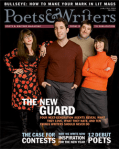 When I see Poets & Writers in the mailbox, my brain goes into a spaz. I suspect that if anyone were within five feet of me they would hear an audible groan. The right and left side of my brain each go haywire.
Either side of my brain would be happy to light up with anticipation when it sees Poets & Writers, but they both know they will suffer the same disappointment that accompanies each issue.
This magazine is advertisement heavy. Ads must fill 65% of it, perhaps more. MFA programs are a dime a dozen and they glut the pages of Poets & Writers.
Because it’s ad heavy, it’s difficult for me to trust any potentially inspiring articles in Poets & Writers. While this magazine’s title would make one think it’s in some way literary, it’s not. In one way or another (ads or articles) it’s promoting sales – of MFA programs, of retreats, of publishers, of agents, or of the presumably hip new writer or hip long-term writer or that writer’s new book. It is all about marketing, plain and simple. Sometimes I can’t tell an ad from an article.
I have come to know that in Poets & Writers I will read about how established and up-and-coming writers promote themselves (in part, by writing articles about their writing for Poets & Writers).
It’s taken me a long time to reconcile to this fact. But reconciled I am. I subscribe to it for one purpose – to keep track of writing contests. That’s it.
I’m not sure why this magazine bothers me so much. I think it wouldn’t bother me at all if the magazine were titled “Marketing for Poets & Writers.” Yes, that would do it.
I recommend this magazine only if you go into it knowing it’s all about promotion. Don’t expect to read good poetry or good fiction/non-fiction by poets & writers. For that, subscribe to The Sun Magazine.
the five people you meet in heaven by Mitch Albom

I’ve just read Mitch Albom’s book, the five people you meet in heaven (Hyperion, 2003). I liked it. It’s not a book that will be remembered as a literary classic, but it’s literary none-the-less.
A quick read, the five people you meet in heaven takes on the themes of family, life, love, death and the morality of war – specific to this last theme, the impact of “collateral damage.”
Not one of these themes is insignificant, yet the story is simple and easy to read and even pleasant, ultimately.
Albom shows humans at their best and not-so-best but offers hope of redemption, peace and love (the greatest of these) for all.
I recommend this book if you are in the mood for straightforward thoughtfulness, and nothing preachy.
Monday’s Maven – NPR’s 100 Must-Read Books For Children Ages 9 – 14
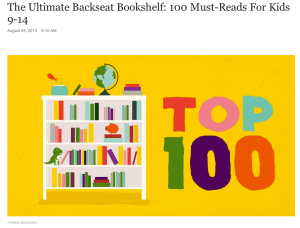
Click on this image to go to the NPR article – 100 top books recommended for ages 9-14
This Monday’s Maven post is not about a tangible product, but a list. In August 2013, NPR put out its recommended list of the top 100 books for children ages 9 – 14. I came upon it recently and as I reviewed it, I was reminded of several books I have loved.
Many of the books on the list I haven’t read but certainly saw on the bookshelves of my childhood home as well as on the bookshelves of the home in which I raised my own two avid readers.
Below is the list of some of the books on the NPR list that I’ve read, some at the suggestion of my children, such as Harry Potter series and Ella Enchanted and The Hatchet and Holes and The Giver as well as the two series by Philip Pullman and Susan Cooper. Of course, like so many of you, I remember the Harry Potter series as being a delightful craze in our house for two years or more. Each book release was anticipated with the same thrill and excitement that I remember surrounding the release of a Beatles album when I was a teen!
The books listed here left a lasting impression on me.
A Tree Grows in Brooklyn by Betty Smith
Little House Series by Laura Ingalls Wilder
Charlotte’s Web by E. B. White
Anne Frank The Diary of a Young Girl by Anne Frank
Harry Potter Series by J. K. Rowling
Little Women by Louisa May Alcott
The Giver by Lois Lowry
The Golden Compass, The Subtle Knife, The Amber Spyglass by Philip Pullman
Holes by Louis Sachar
The Dark Is Rising series by Susan Cooper
Ella Enchanted by Gail Carson Levine
A Wrinkle In Time Series by Madeleine L’Engle
Hatchet by Gary Paulsen
As soon as I finish writing this post, I’m going to send the link to the NPR list to my children so they can have the same enjoyment I have had reviewing the list.
I hope you, too, find some forgotten treasures as you review the list. And I hope the list inspires you to have a look at some not yet read, as I plan to.
And, most of all, perhaps we should consider these books when giving gifts to the young people in our lives.




 sublime days