Annie Leibovitz, revisited

Annie Leibovitz This image was originally posted to Flickr by Robert Scoble
A few weeks ago I posted about Annie Leibovitz — about how I’m reading her book Annie Leibovitz At Work. I’ve nearly finished the book. I savor it, reading two or three of its short chapters each week. I like to let the ideas of each chapter sink in before I move on to the next. I highly recommend the book, whatever your artistic media.
Today, I came across an article about Leibovitz’s Dream Portraits, a project she’s doing for Disney Parks. The article tells of, and shows through her images, her creative genius.
Like all genius artists, Leibovitz hasn’t escaped criticism. She goes to bold photo frontiers, and she takes her subjects and viewers there, too. Sometimes, some feel that she’s gone too far.
I hope you have time to read the article and enjoy the amazing photos she’s created, especially if you are looking for fuel for your creativity. She’ll inspire you even if you are not a visual artist, but a writer.
And when you have the time, consider reading her book Annie Leibovitz At Work.
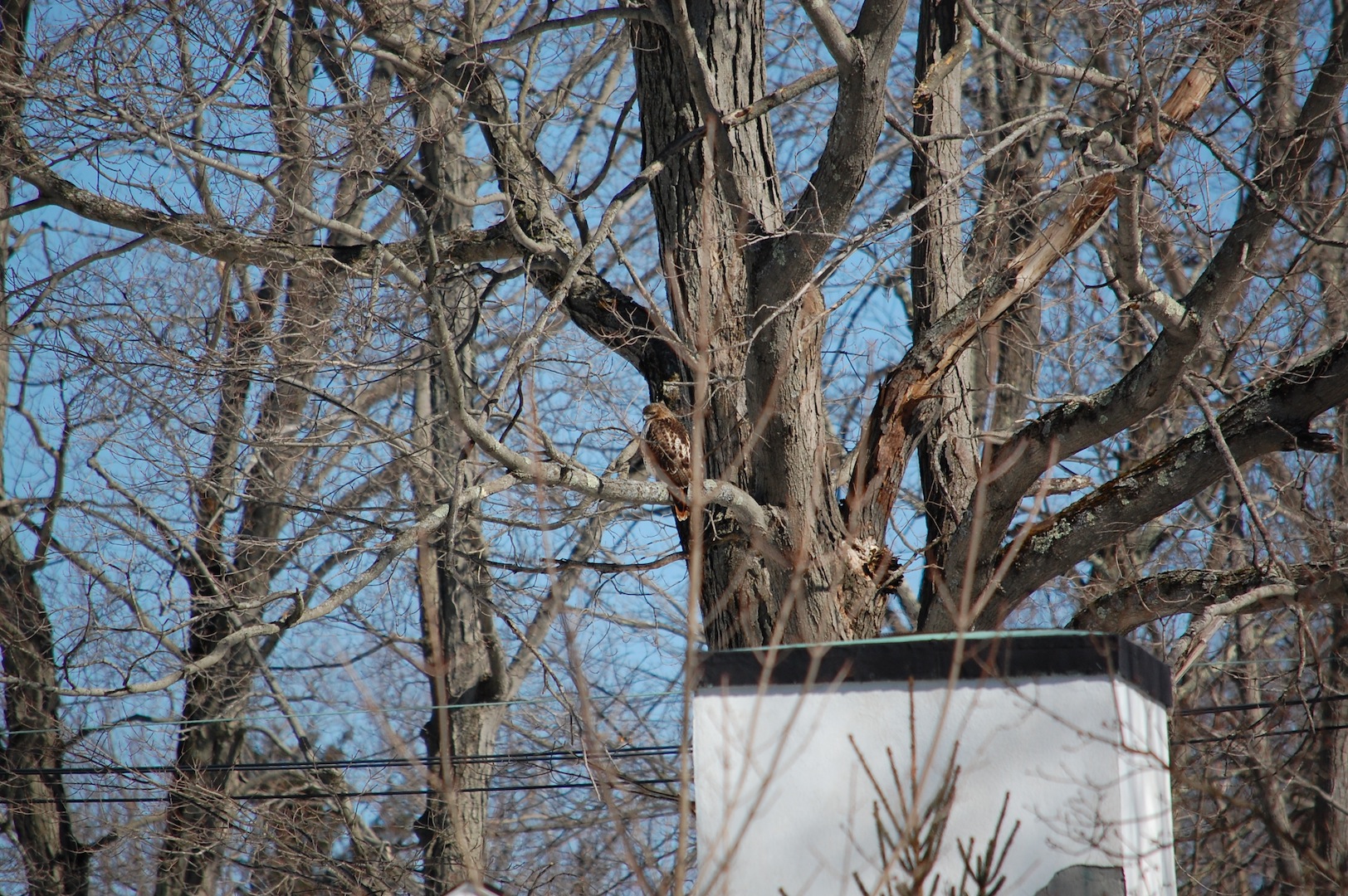
Sunday’s Snapshot, a red-tailed hawk

During the day as I sit at my desk, I have a lovely view of my back yard if I look up from my computer.
Some days, I’ll become aware of a large shadow passing across the yard. Usually, around the third pass, I’ll become more conscious of the shadow and I’ll realize it must be a red-tailed hawk flying low in search of prey.
Sure enough, if I scan the trees, I’ll find it.
The red-tailed hawk is quite common and a couple of days ago, through a kitchen window, I saw one glide across my view and land in a tree about 150 feet away.
I got my camera and went out to the front steps where I was able to take photos for several minutes before my hands got too cold to handle the camera well any longer.
I’m satisfied with the photo above. These shots of a hawk in a tree are bound to have obstructed view. Photos I took a few weeks ago of a hawk were completely out of focus as there was just too much branch interference for me to achieve even a good manual focus. I couldn’t see the bird well enough to get the focus. Today, the autofocus did a great job finding the hawk so I didn’t even try manual. And the colors are true which really pleases me.
I don’t think I’m exaggerating if I say this hawk was at least 18 inches tall, crown to tail tip.
Once I downloaded all the images (about 25 of them) and picked the one in this post as the best, I cropped it. I’m amazed the resolution and focus held so well with such a close crop.
A note: Sometimes when I am working a shot like this, I find that I instinctively hyper-focus. That is, quite intensely, I keep both eyes wide open – with one eye looking through the viewfinder and the other looking at the subject directly. Doing so really helps me “find” and “hold” the subject when there is great distance between me and it. And the image focus ends up being better.
So that you can appreciate the photo above more, below is the original photo, taken with a 300mm lens.
And to help you imagine even further, with the naked eye, I could barely find the bird in the tree it was so far away!
I first heard the Leonard Cohen song Bird On The Wire in the late ’80s after I’d watched the movie Bird On A Wire and The Neville Brothers’ version of the song played through the final scene and as the credits rolled. I’d never heard Aaron Neville and for days the distinct sound of his voice stayed with me and made a fan of me.
It was years later before I heard a Leonard Cohen version. Any of his are just so moving.
Cohen’s version is above, the Neville Brothers’ below. Either way, the song is a long-time favorite of mine.
Five Fascinating Facts about John Steinbeck
I thoroughly enjoy the Five Facts series that Interesting Literature features regularly. This John Steinbeck one is wonderful – especially if you take the time to go to the link showing the full text of the letter to his son Thom. Wonderful.

2. In the 1980s, a rumour arose that Steinbeck’s novel The Grapes of Wrath had been translated into Japanese as ‘The Angry Raisins’. This rumour was, however, false. It is a good example of how people love a good ‘lost in translation’ story, and it…
View original post 365 more words
Creative Inspiration via Neil Young and Bob Dylan
In 1969 and 1970, when I was 14 and 15 years old, it was Bob Dylan’s album Nashville Skyline and Neil Young’s After the Gold Rush that I listened to some nights in order to blocked out the world and swim in the angst of my unrequited love of a friend of one of my older brothers.
Love at that age has a pure and true nature of its own. If it could be bottled and sprinkled around the world we’d live in a much better place.
Bob Dylan and Neil Young (and the bands he was associated with) were my favorite musicians of that time though there were so many others, for me, in the same orbit – The Beatles, Van Morrison, Jimi, The Allman Brothers, The Doors, The Supremes, Simon and Garfunkel, James Taylor, Joni Mitchell, Janis, Stevie Wonder. And Carole King has to be singled out for her prolific songwriting contribution to the music of that era.
Even today, some of the songs from Nashville Skyline and After the Gold Rush bring back the melancholy of my long nights at home, as I sat in the dark for hours listening through huge headphones to Only Love Can Break Your Heart, Don’t Let It Bring You Down, and Oh, Lonesome Me (from After The Gold Rush), and To Be Alone With You, I Threw It All Away, Tell Me That It Isn’t True, and Tonight I’ll Be Staying Here With You (from Nashville Skyline).
Though it wasn’t considered one of Dylan’s best albums, Nashville Skyline is a favorite of mine – probably for sentimental reasons. I love every song on it, even still.
After the Gold Rush achieved acclaim in time but the talent of Neil Young was not lost on me when I first heard it. I listened to that album over and over, getting more meaning from it with each spin of the vinyl.
That’s a long introduction to the purpose of this post. The point I’m making above is that, for me, when these gents sing or talk, I listen.
This past weekend, I stumbled into online recordings of interviews with both Bob Dylan and Neil Young in their older years. The interviews address their creative journey, which for each was a deliberate, single-minded focus on their music and, very consciously, not on market demand.
I don’t think that every artist, writers included (since this is a writer’s blog), who sticks to the inner inspiration that drives his or her artistic impulses will reach the heights of success that Dylan and Young achieved. But I do think that if artists following that inner inspiration, their gift to humanity will be of better quality.
Whatever your artistic craft, I hope you’ll set aside time to watch and listen to these interviews.
In watching them, I found that Dylan is forever Dylan – he’s one of a kind – and Young, I suppose, is forever Young (intended) as he kept in step with the organic evolution of music, a recurring birth. Young is also an engaging, comfortable-in-his-own-skin, funny and serious person.
Sunday’s Snapshot – Fruits of My Labor and Joy
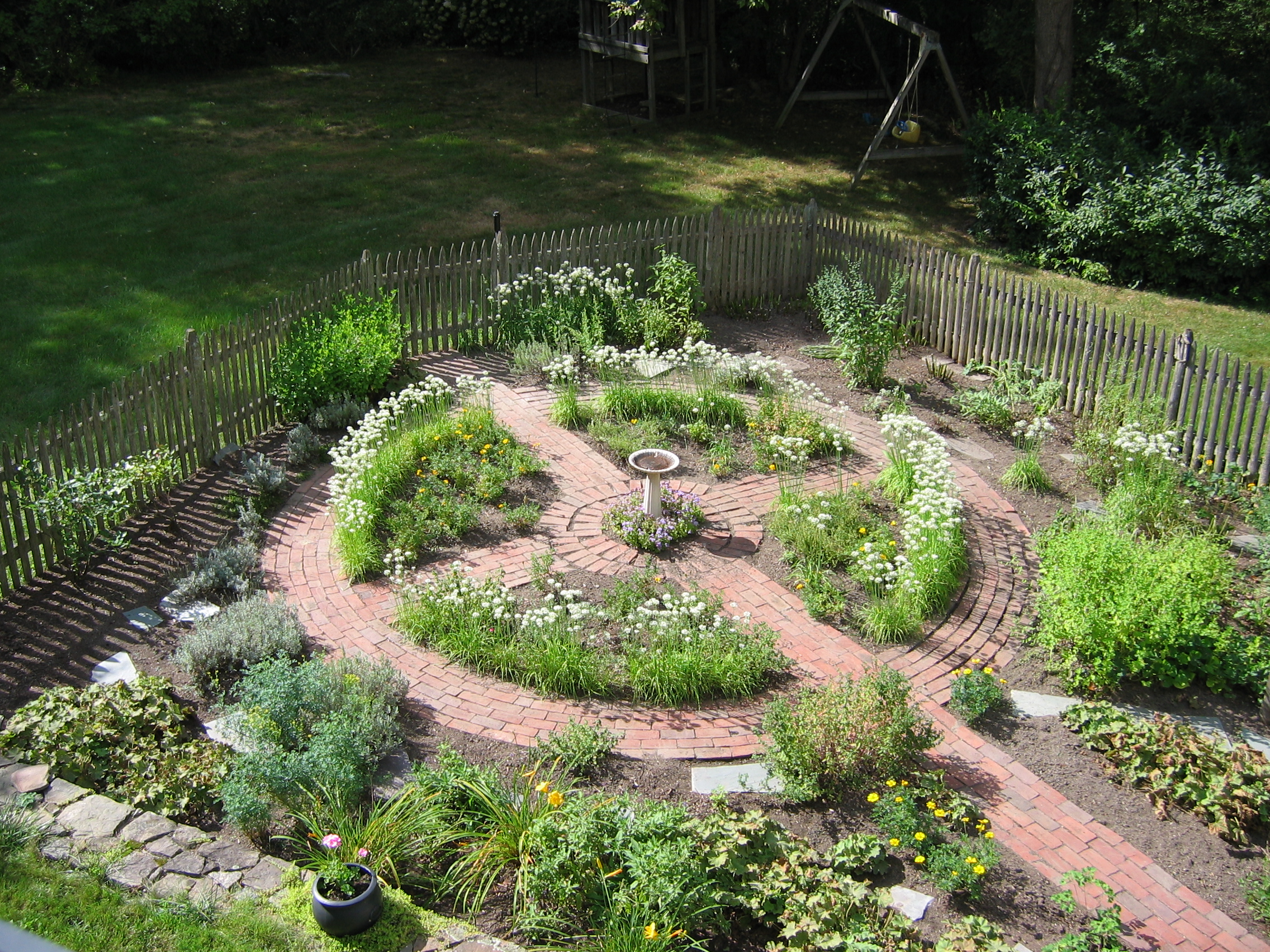
My creativity has morphed through the years from sewing to cooking to gardening to photography to writing. Many of these things have overlapped with one another or been revisited after some time away from them.
Much of the backyard of our family home in New England, was covered with a formal English herb garden that had been planned and planted by prior owners. I didn’t know a thing about gardening when I brought this garden back to life after so much neglect that none of it could be seen beneath a small meadow of wild grasses. The people who had planted it were long gone, back to England, and those who lived in the house in the intervening years didn’t tend the garden.
For about ten years, the herb garden became my creative obsession – not just the tending of the garden itself, which filled many hours of the week, but making tinctures from the herbs or using them in my cooking, or drying them for house decorations or arranging their flowers in vases.
I loved when late afternoon came on a summer day and, as I prepared dinner, I’d step out the back door to my garden and pick from it enhancements for my simple menu.
The brick pattern in the garden required more maintenance than the quadrants the brick created. Weeds were forever growing between the bricks and removing them was no small feat. I never used chemicals, as we ate from the garden. So, I’d get on my hands and knees and bit by bit weed all the brick work. I used a chisel-like tool that I’d wedge between two bricks, then rock them gently till the soil loosened and released the weeds to my tug.
One time I took up all the brick, cleaned out all the roots of anything that grew in the brick pathways and then put the bricks snuggly back in place.
I can tell you by looking at the photo above that it was taken late in the season. I know this because the lady’s mantle is browning and the blossoms of the garlic chive are blooming.
And by the look of the brick (not a weed to be seen!), I’m guessing I’d just put in a full day of weeding.
The view of the garden is through the window of an upstairs bedroom, the same window I always used to get as much of the garden as I could into one frame of a photo.
The garden was a labor of love that came to an abrupt end when I developed fibromyalgia and then moved from that home when I could no longer care for it. It was heartbreaking for me to leave the garden.
But I still love to look at my photos of the garden and remember the feel of the warm sun or a cool rain as I worked, the scent of the earth and the scent that the plants released as I brushed against them (especially the lavender) while working, and the flavors of the fruits of my labor.
It is an image very similar to the one in this post that I used in the cover design of my first novella, Love’s Compass. Also, drawing on the themes of the meanings of herbs and flowers, I studied each chapter after the story was written and identified the flower that best represented the theme of the chapter and noted it at the start of the chapter. So, for instance, the page before the second chapter looks like this:
 It was a joy to weave my gardening knowledge into the design of Love’s Compass. As I think about it, a gardening scene appears briefly in The Setting of the Sun, too. Since I’d never created a book jacket before, I was pleased with the outcome of the Love’s Compass jacket. Here it is:

Saturday’s Song – Dink’s Song, by Dave Van Ronk
Well, Saturday’s song this week is a repeat of last week’s song. But this time it’s performed by Dave Van Ronk.
In talking around through the past week, I’ve learned that Dink’s Song (which has, over time, also come to be called Fare Thee Well) is an old American folk song, best recorded (many think) by Dave Van Ronk. Having listened to Oscar Isaac’s version as well as Bob Dylan’s, Pete Seegers, Jeff Buckley and others, I’d agree that Van Ronk’s studio version is the best. But that’s just opinion. You might feel differently.
The Wikipedia page about the song informs that, “The first historical record of the song was by ethnomusicologist John Lomax in 1908, who recorded it as sung by an African American woman called Dink, as she washed her man’s clothes in a tent camp of migratory levee-builders on the bank of the Brazos River, a few miles from College Station, Texas and Texas A&M College.”
Now Dink’s version is the one I’d love to hear, but it’s long gone. And I suspect that’s the one I’d put at the top of the list. Read more here and note that this article cites 1904 as the first recording date.
Queen of Peace – a poem by Mary McAvoy
Queen of Peace
by Mary McAvoy
Her legs bow with the weight of the children of the universe.
She carries the power of the four winds and the rain along with them,
and the sun that grows the food that feeds them.
She alone can part the seas
and her pace is not broken by anything that blocks her path.
For all eternity, she’s trudge through every day –
over, through or around any obstacle –
to bring her children water and whatever morsel the earth
gives up to her through the cracks in its parched soil.
The folds of her clothing hold the dust of every continent
and her eyes, the heartbreak of every human tragedy.
She is too small for such a charge.
But each moment of each day she puts one weary foot before the other
as she has done for all time.
No man or beast has the strength of her frail body.
She is mother.
She is love.
She is the Queen of Peace.
◊ ◊ ◊ ◊ ◊ ◊ ◊ ◊ ◊ ◊ ◊ ◊ ◊ ◊ ◊ ◊ ◊ ◊ ◊ ◊ ◊
This poem was inspired by my reaction to a photograph by Joshi Daniel. The photo is titled Weary and was posted February 14, 2014 at Joshi Daniel’s photography website. I posted about the photo yesterday and the day before.
A Picture and Words
Yesterday, I shared with you a photo by a super talented photographer, Joshi Daniel, whose blog I’ve been following on WordPress for a while. He photographs people and about half his work is in black and white.
I gave you a link yesterday to one photo in particular, Daniel’s post from February 14, titled Weary. Rather than post the photo on my site, I gave you the link to Daniel’s site so that you could see it in his site’s design, which showcases his work so well.
I didn’t want to talk about my impressions of the photo until you had a chance to see it. So, I hope you have and that you’ve experienced your own thoughts and reaction. For several days after the photo was posted, Daniel received a steady stream of likes and comments – all complimentary.
As for me, although I’m always amazed by Daniel’s work, this photo took my breath away. Immediately, I saw eternity in this image of a woman. I see her as the eternal, female, divine love.
Since first seeing the photograph, I have thought how that image said more than I could ever manage to write even if I wrote a novel about the woman – who I see as every woman.
As a photographer, I know how an image can convey enormous emotion and thought. And it’s really impossible to express in words what some images show – like Daniel’s photo.
Still, I challenge you writers to try to write what you saw when you first looked at Daniel’s photograph. And I think you know I don’t mean that you are to try to describe the photo, but try to say what it conveys to you.
I’ll do the same and perhaps share what I write here at sublime days. If you like, please share your writing in the comments or share a link to your writing.
This exercise is not meant to trivialize the photo. On the contrary, it’s meant to compliment Joshi Daniel. I don’t think words can match what he’s captured.
Joshi Daniel’s February 14 post – A Photo Titled Weary

I follow many photographer’s blogs. Joshi Daniel Photography | Images of People is right up at the top of my list of favorite sites.
Sometime I’ll post about some of the other sites as well. But at the moment I want to share with you a photo Joshi posted February 14th. I want you to see it in the context of his site, so if you click on the image of his banner, above, it will take you to the photo, which is titled “Weary.”
Tomorrow I’ll write more about the thoughts the photo has stirred in me.
For now, if you have a minute, go have a look. If you like his work, please support Joshi with a “like” or a comment. Thanks.




 sublime days