Auld Lang Syne – 2013

Golden Sunset
photo by Mary McAvoy
Days Gone By
by Mary McAvoy
He poured me a thimble of sturdy port,
he drank his from a sturdy glass.
He held my small hand with love so dear,
’tis a memory never forgot.
And he sang me a song sweet to my ear,
a song of long ago.
I said to him, Pa, what does it mean,
the song of auld lang syne?
He smiled at me so sadly,
and he smiled at me tenderly,
and he said, much later – when you’re like me –
you’ll know about auld lang syne.
‘Tis a song o’ friends, and a song o’ time,
and a song o’ no goin’ back.
‘Tis a song o’ love and keepin’ in your heart
those who were once to you dear.
Long now he rest in the vale,
and longer still the seas have roared ’round me.
but true as his word, and I hear them clear,
I know of auld lang syne.
So many I remember with love
so many are forever dear
still one holds a place in my heart
never to be lost from there.
We twa hae run thru the night, my dear
and on ’til morning came bright,
then later we went ’round again
and cried back into the night.
I raised a pint to you last night
and surely you raised yours.
Tears soaked that place in my heart for you –
forever, for auld lang syne.
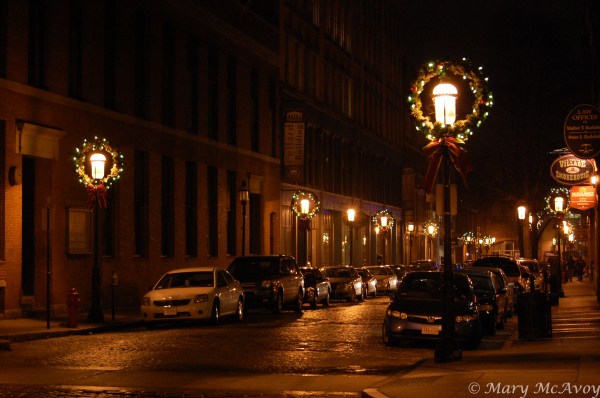
Christmas Season in Lowell, Massachusetts
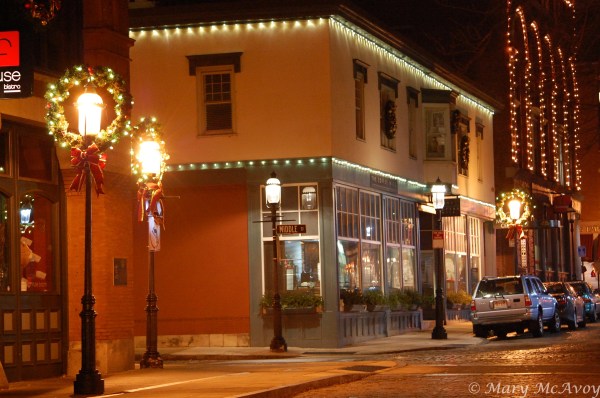
Cobblestoned Middle Street at Christmastime – Lowell, Massachusetts
Since moving to Lowell in June of this year, I haven’t used my camera as much as I had in prior years when I was chronicling the seasons of a pond near my former home. My photoblog SilverLining-MaryMcAvoy is loaded with images I took over the course of five years.
Two nights ago, I went out into the streets of my new neighborhood in downtown Lowell, Massachusetts and setting up a tripod at various corners, I took this selection of photos with the hope of capturing the Christmas mood here. It’s really lovely.
Enjoy these photos!


Go See “Searching for Sugar Man” – the story of Sixto Rodriguez
This evening, for an hour and a half, I bumper-to-bumpered my way through rush hour to the nearest indy cinema to see the 6:35 p.m. viewing of “Searching for Sugar Man”, a documentary by Malik Bendjelloul. A good friend from NYC, who has her finger on the pulse of many things art/literary, told me about the film a couple of months ago. She referred to it as “inspiring” and “electrifying” and it is. It’s also humbling and spiritual and re-affirming.
“Searching for Sugar Man” is the true story of an American singer/songwriter, Sixto Rodriguez, who in the early ’70s put out a few albums that didn’t catch on here in the States, despite top-shelf backing. But in South Africa, unknown to him or the American music industry, his lyrics and sound became the impetus in the youth culture that motivated them to dare to buck the system, at the height of apartheid, through their own rock and roll. To the South African youth, Rodriguez was more popular than the Stones, Elvis, Dylan or the Beatles, hands down. And, like Elvis, to them, he’d died tragically and young. Unlike Elvis, this wasn’t true. He was alive and well, living a laborer’s life in Detroit, his home city, after letting go of his music career because, as far as anyone in the U.S. knew, it didn’t take off.
Perhaps I’m late to the conversation, but for any who happen by this post who have not yet crossed paths with this film, to see it is to witness authentic existentialism. While it’s tremendously moving to see the footage of his performances in South Africa in the late ’90s, when Rodriguez is in his 60s (imagine the reaction of an audience if Elvis were suddenly alive and touring…), what is more dramatic to me is to witness Rodriguez’s grounded balance through it all. He is authentically himself throughout his life. Late in life fame doesn’t alter him one iota.
I’ve given away too much here, but I’m brimming with profound spiritual inspiration in these hours after having seen the film. I’m making myself stop now before I bring in Buddha and Jesus and suggest to you that Rodriguez, in our lifetime, exemplifies both.
Here are my favorite songs of his, so far.
The opening of this song resonates as a perfectly pitched-for-me Tibetan singing bowl. In melody and lyrics, it’s a simple but true love song. I invite you to focus on the word “you” and feel the intimacy that that word connotes when love is real.
I Think of You
Here is a catchy tune – the lyrics of which are again simple, but are not as light as the song may sound.
I Wonder
Dylan would have had some competition for the charts through the ’70s….
Crucify Your Mind
Like Janis
…Paul Simon, too…
Street Boy
Cause begs the question, “Have we made any progress in the past 40 years?”
I plan to buy “Rodriguez Cold Fact” as my introductory album. I don’t imagine I’ll stop my purchasing of his music there.
Please go to “Searching for Sugar Man” and see an amazing human spirit.
David Foster Wallace and Depression

photo by Mary McAvoy
My son has been an enthusiastic reader since he was three years old, when he discovered Calvin and Hobbes. He and I have a long history of suggesting books and authors to one another (we’ve just finished Cloud Atlas by David Mitchell, his suggestion), sharing books with one another, and when we lived under the same roof, slyly fighting over time with a single copy of a book we both had interest in simultaneously.
For a couple of years my son has been talking to me about the author David Foster Wallace. As he (my son) read Infinite Jest he’d periodically set the book on my desk, a paperclip marking a section for my suggested reading. I was seriously impressed with the writing and storytelling, as well as Wallace’s use of extensive and anything but dull footnotes.
Last spring, after meeting my son for dinner in Cambridge, Mass., he handed me DFW’s book, A Supposedly Fun Thing I’ll Never Do Again, with the suggestion, “Just read the essay about the cruise,” from which the book derives its title.
So, I read the cruise essay and again I loved Wallace’s thinking and his intuition and his humor and his self-deprecating humanness, laid bare in his engaging writing, which often made me laugh out loud. But every night in the course of my reading I died a small death as an especially thoughtful thought he shared struck me as spot-on and then I’d remember that he’s no longer in this world to help keep us thoughtful about how we live and why we live and how he viewed his world and our world. Then I’d remember, too, that he died by his own hand and my thoughts about depression and suicide and the heartbreak of genius people who die of suicide would overwhelm me into my own sadness. So, I set the book aside – but not till I finished a second and a third essay, including “Derivative Sport in Tornado Alley”, Wallace’s excellent stream of thoughts about his youthful time on the tennis court (which he saw as a grid of lines and vectors and intersections, cut and crosscut by the path of the ball, and on which regional weather thwarted or enhanced (in his case) the player’s game).
Now, three months later, my son has read and, in a recent visit when I was not home, left on my desk the newly released biography of David Foster Wallace, titled Every Love Story Is A Ghost Story – A Life Of David Foster Wallace, by D.T. Max. I’ve read the cover, front and back and inside flaps, twice. I’ve looked often at Wallace’s photo on the front. I think about reading the book but I haven’t yet started it. And my son has warned me that it’s terribly sad. He says not to worry if I never get around to reading it.
Human tragedy of the David Foster Wallace proportion saddens me to the core. I stagger under the weight of it while trying to make sense of it. Lost genius is tough enough, but lost genius caused probably by genius itself confounds me.
I have a theory that what we call “depression” in people is the collective human mind in a growth spurt. In my theory, there are people all around us who are in the process of advancing the brain power of humanity. But as they do, they don’t fit in comfortably with humanity, now. This world becomes too painful for them. They suffer for their sensitivity to what they know or intuit or clearly see or can’t clearly enough see. Their pain is raw, like the scrapes you might remember from a fall from your bike. But for them, the pain is pervasive, through their entire being. They cry from the weariness of bearing the pain, caused not by a fall from their bike, but from living.
Based on my theory, I wish there were a place for “depressed” people, an oxygen rich place where the sun shines to perfection. A place where the woes of life do not exist. A place where by whatever it takes, both inner and outer peace would sustain them and free them from suffering and keep them alive and healthy. I’d like to see “depressed” people elevated to a place in society that values their keen sensitivity as invaluable to our survival.
Anyway, I haven’t started to read the biography yet. I know that to read of Wallace’s struggle with depression and to think of the loss of his life and his potential work will be heartbreaking and frustrating. But I also hope that in his story I find some better understanding of depression or a clue to what it might take for us to help others like him to live. So, maybe I’ll tip toe through it, a few pages at a time.
Let Me Call You Sweetheart
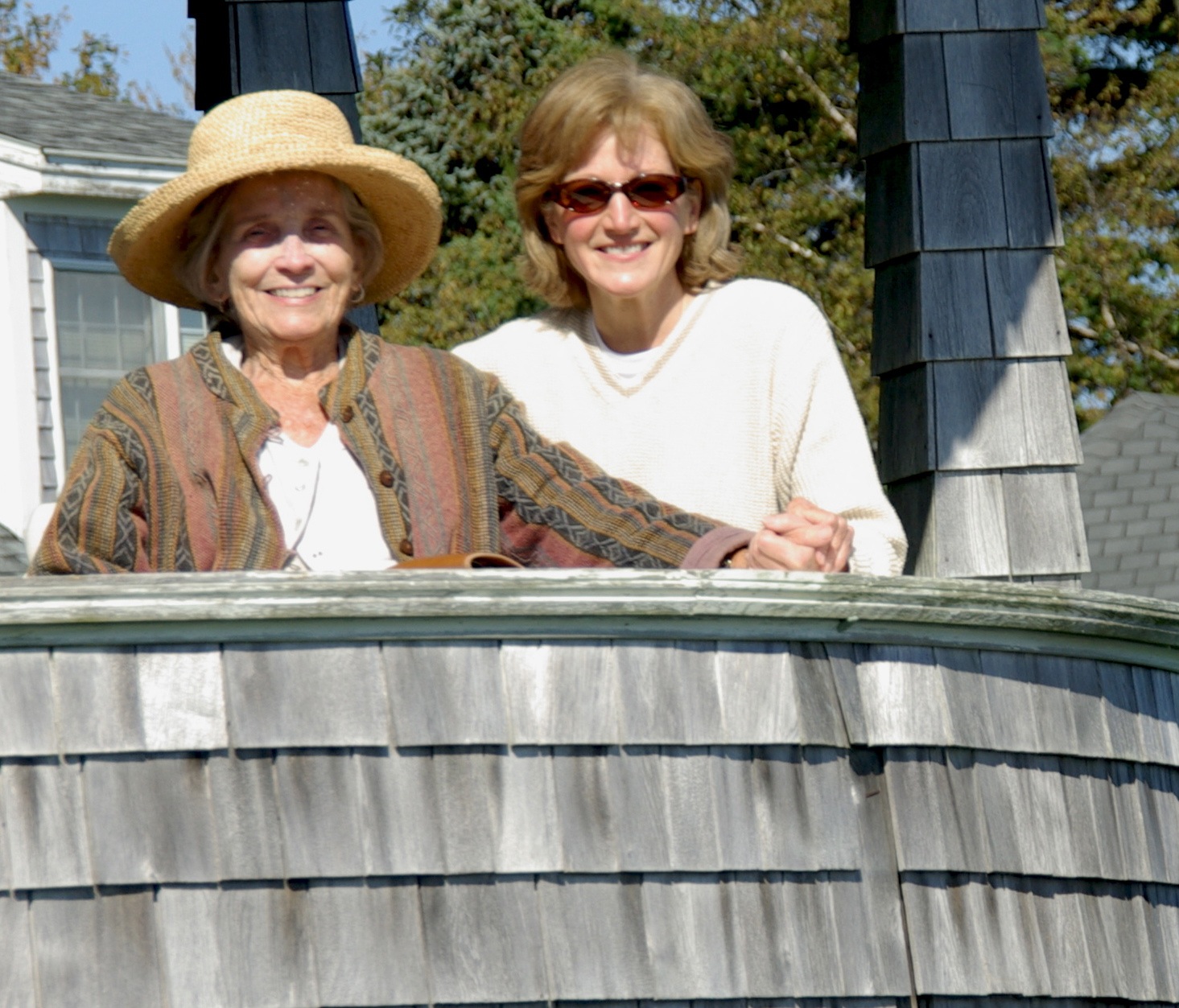
Mum and me – 2009
I didn’t foresee still visiting her nearly a year after her death – though every time I left her in the three years before, I’d look out the windshield of my car as I’d ready to back out her driveway and I’d see her small frame standing on the other side of the screen door, she no longer the statuesque 5’7” of her younger years but a fragile being of about 5’3”, as she’d gaze out over the lawn and through the branches of the ancient trees that lined the driveway and on up toward the street and to her mailbox, studying her one acre of land that my father and she bought in 1957 when I was two. When she’d hear my car start she’d look toward me and I see her say “Bye, Mare” and I’d prematurely mourn my mother’s passing as I’d watch her and wonder, “What will I do when she’s gone?” The thought would shatter me and I’d drive home with sorrow tightening my throat and melancholy filling the rest of my day and guilt permeating my heart for not doing more for her.
Sundays were my days to visit though I didn’t get there every Sunday. But when I did we’d chat about everything and nothing and I’d give her a backrub and put lotion on her skin and try in any way to make contact in a soothing and comforting way.
I took her to her doctor appointments, so, often I’d have an afternoon with her during the week. I cherished my time with her, knowing how much I’d miss her and how sad I’d be when she was gone.
We laughed a lot when we were together. Often, the laughter came about after one of her spoonerisms, for which she had a long and humorous history in our family, or one or the other of us – both shy by nature – suffering through a social embarrassment as we bumbled along, she wheeling her oxygen tank and me tooling along as I wheeled the spare behind me. I’d joke that she’d lived so long I’d grown into her age category and wouldn’t it be fun to be old together.
Often in her last years and after a day with her, I’d say, “Mum, give me warning before you leave. I’ll need time to pack for the journey.” Covertly, I’d add, “I’m going with you! There’s no way you’re going on the big adventure without me.” We’d laugh as we thought of the faux pas of our day and imagined ourselves fumbling through the gates into heaven. Really, we both knew I was trying to ease her thoughts of death, trying to let her know I’d be with her for as far as I could go. And I was.
My mother was lovely, always gracious. She was pretty even at age 89, her age when she died. She had warm blue eyes. In her final days, all twelve of her children would sit with her ‘round the clock – in shifts or all together, desperate in twelve different ways to spare her any suffering. We’d talk softly to her when she no longer could, and we’d pray aloud the prayers familiar to her, and we’d sing “Let Me Call You Sweetheart”, one of the first pop songs she remembered liking as a child. And I could hardly get out the line, “let me hear you whisper that you love me, too” because, in that final week, one of the last recognitions that passed between us was when I had to wrap my arms around her and move her to one side as I helped her nurse change her bedding, and when I held her, as gently as I could, she grimaced in pain. It upset me to cause her more discomfort than she already had. With all my heart I said, “I’m so sorry, Mum.” She opened her eyes and gave me a weak smile of forgiveness. As I held her gaze, I said, “I love you,” and she whispered, “I love you, too, Mare,” before she closed her eyes again.
So now, I find myself on Sunday afternoons, driving to her house and letting myself in and absorbing the impact of everything being just as it was when she died last November, except that she’s not there. Until October, we didn’t know she was dying and she lived fully late into the summer. So her house is as it was on any given day for the prior 55 years. The placemats are on the table, the sugar bowl on the counter, her spices ready by the stove. Her ironing board leaning in a corner, her b&o waiting for Billy Holiday, her easel and paintbrushes sitting, waiting, her windows to the outdoors longing for her appreciative look.
I walk past the bedrooms of our youth until I reach the door to her room at the end of the hallway. I’m struck by the silence – an unnerving stillness, and her empty bed. In my mind, I greet her as I always did, “Hi, Mum!” And I can now just barely hear her say, “Hi, Mare!” as she always did with real delight.
I fill with tears as I enter her room. I stand and think, what shall I do first this time? Look at her paintings on the walls and be tempted to touch each stroke? Raise the shades and fill my eyes with the view she loved? Open her closet and look at her clothes and remember helping her in and out of them through last year, touching something that not long ago touched her? Or open one of her twenty-five year-long journals and listen to her describe an ordinary day in her life. I know what I’ll find on almost any page. She’ll mention news about or a visit from one or two of her children or grandchildren or a friend, she’ll comment on the political scene in Washington, which she followed like an avid fan, she’ll plot out her frugal expenditures to keep the house lasting as long as she, she’ll describe the weather and mention the scenes of nature out her window. She might say, “Read in the sun on the patio for three hours! A perfectly beautiful day!”
Always, I choose to sit at the table by the windows in her room and read from her journals. Sometimes, I get so lost in her talk, I am with her. I’ll smile at a simple something she’s written, but when my eyes lift from the pages and I’m brought up sharply to the reality that she’s gone, my heart breaks again.
She was more than my mother. She was a unique woman who loved the gift of life on earth, a place she loved – troubles and all. She was both feminine and strong. She stayed current but held tightly to the social standards, courtesies and morals of a by-gone era. She was nobody’s fool, and we all aspired to have some of her grace.
I can’t imagine I’ll ever get used to life without her.
Half Moon Revisited

Ashfield, Massachusetts
Half Moon Revisited
(or, Honoring the Past)
Saturday
I wandered upstairs and down and room to room,
Recalling, without regret.
I walked Main Street after dark, to remember.
Then I wrote and wrote so much more than anytime before, till night was spent.
Sunday
I walked the side streets, faster and farther than we’d ever gone.
Golden light drew me to birch groves, and thoughts of shutter-gifts from you.
I lingered at the bench.
The gazebo sat me down and a whirlwind kicked up and blew stinging sand – drama,
like the first time – thunder, lightning and driving rain,
and your warm leg against mine.
I pause, not too close to the couch – where I might fall into that moment again.
I write and write and write of love – thousands of words of love.
Monday
I pulled open the door to St. Johns and sat vigil in the Easter pew,
silently reciting the poem that came as a miracle while there with you.
I walked in the clear cool beauty of black night.
I stopped, stood, still –
looking through the branches of the kissing tree to the brilliant, perfect half moon.
Could you see it out your studio window? Would you think of me?
I stood in the driveway and leaned my back against you
and felt your arms wrap around me.
I look up and drink in the milky-way while a billion stars twinkle wink at our ghosts.
Tuesday
I see that, all the while, you were writing a sweet story of play-acting in your domestic life
with your “love found” as your bride.
You wove in dangling thoughts of the same half moon and the same stars.
Wednesday
Speaking strictly for me (ref. JB to BD in D&R),
the moon and stars will forever be ours,
indifferent to our new loves.
Thursday
This poem.
Friday
Before I leave here, my writing done, the story will be finished, finally over,
and it’ll long since be time I hear no more from you.
Saturday
Jerome and Topaz dance to Little Trip To Heaven.
The End.
Sunday
I drive home under a blanket of hurricane clouds knowing the full moon shines above.
I’ll return to my life, and you’ll remain in yours.

Birch Trees in Ashfield, Massachusetts
Fibromyalgia – not so long ago, the “f” word
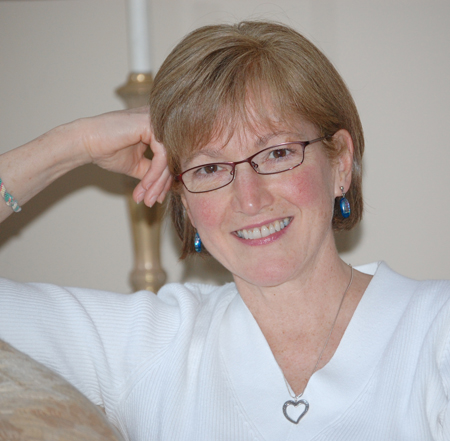
The Picture of Health with ME/CFS
A few days ago, I received a newsletter in my email that informed me that today, May 12, is National Fibromyalgia Awareness Day. Who petitions for or decides on something like that? The federal government? The CDC? A board of physicians (I doubt it)? One physician (maybe)? Hallmark? Anyone? Anyone? Bueller?
I suppose “awareness day” is quite different than “national holiday” and I wonder how many “awareness” days fill our calendars and to what gain.
**** Pause. When I sat to write this post, I didn’t know the opening would take this tone. So, I’m sitting still thinking, “Yikes, where did THAT come from?” ****
Maybe from here. Ten years ago I woke from a simple 45 minute surgery a changed person (I now presume the anesthesia was the culprit). Over the next four years my life was stripped of :
– sharp cognitive function
– physical abilities I had enjoyed, without thought, for years (gardening, power walking, yoga)
– my job, as my energy was unpredictable (and could go missing for weeks) and my cognitive function was dismal
– my home, which I could no longer care for and the stairs of which I could no longer climb
– my 26-year marriage (my former husband surmises our marriage ended because I now start my day so late – the crack of noon to be precise, quite typical of a person with this condition)
Until the day of that surgery, anyone who knew me would have characterized me as a “type A” personality. I thought fast, I talked fast, I moved fast. I got a lot done in a day.
After the surgery, I couldn’t remember the names of dear friends, I had the speed of a slug, I had the energy of….whatever has NO energy. It took me nearly two hours to shower, since I had to rest so often throughout the process (the washing process…the hair drying process…the dressing process) – things I had never thought about as “processes” in my prior healthy life.
What frustrated me the most was that my legs had gone dumb and heavy – not weight-heavy (to the contrary, I was losing what precious little weight I could afford to lose), but unresponsive heavy. I felt as if I were dragging them around rather than that they carried me, without thought, to wherever I needed to be, as they always had in the past.
I saw no less than 20 medical doctor specialists. At first my condition was thought to be MS, then lupus, then Lyme disease. Maybe it was rheumatalogical, they’d say, or maybe some other auto immune condition. Or maybe, my favorite doctor surmised, “It’s McAvoy disease” – my own unique physical decline.
I was constantly exhausted. And by “exhausted” I don’t mean super tired. I mean that there was zero energy in my body. No gas in the tank. Nothing. I often felt as if I were evaporating, that the molecules of my being were dispersing like vapor — there was no core engine holding me together and at a steady idle. To breathe was an effort. To sit upright was an effort.
I couldn’t think, I couldn’t sleep. My life, as I’d known it, was slipping away.
One day, about three years into my undiagnosed condition, my primary care doctor asked me if I’d ever heard of “fibromyalgia”. He said this “f” word in a whisper. I couldn’t understand what he was saying, so I asked him to repeat it. He did, still in a whisper. Whatever he was saying was not familiar to me. His whispering, I later realized, came from his feeling that he was saying a bad word in the medical community. He didn’t want his colleagues to hear him use the “f” word. When pushed, he said it loud enough for me to sound it out and later research it in the privacy of my home.
It was another year or two before I was definitively diagnosed with fibromyalgia and chronic fatigue. This lag in diagnosis is typical, as typically physicians considered the symptoms of this condition (from which some men suffer, too) “female hysteria” or “yuppie disease”. I think the same physicians would put childbirth in the same category, if not for the fact that there is evidence of childbirth in the real presence of an infant after nine months of what they would probably consider hysteria. Ditto menopause, but for the blood work they can now count on to validate treatment.
Fibromyalgia, or whatever you choose to call it, is now presenting with evidence of its existence in brain imaging. So, western doctors, who are scientists more than they are healers (my opinion) now take note of it. And, as well, there is so much money to be made (by all parties involved, except the patient) in the prescribing of a wide range of medications (where the real rubber hits the real road in real, modern, western medicine) that to treat patients with this condition is becoming a no-brainer for the business-driven acumen of many physicians.
For ten years now, I’ve had fibromyalgia/CFIDS (chronic fatigue immune deficiency syndrome), or ME/CFS (myalgic encephalomyelitis/chronic fatigue syndrome) as it’s now being called. And, yes, I have a serious attitude about how my health was “managed” for the first six years I was treated by the medical community – which treated me as suspect, cuckoo, as if exhibiting hysteria, playing the system, looking for drugs, etc.
Long ago, I stopped expecting the medical community to help me, and my new sensitive system could not handle the medications they continuously prescribed. My greatest relief from the pain and stiffness of fibromyalgia and the exhaustion of chronic fatigue comes from an “alternative” treatment, Network Chiropractic (sorry Pfizer), a light touch form of chiropractic practice that helps balance the sympathetic and parasympathetic neuro-pathways. And I found inspiration from such people as Stuart Murdock (of the music band Belle and Sebastian) who had CFS at a young age (and for the most part, overcame it) and Laura Hillenbrand (author of Seabiscuit: An American Legend and Unbroken: A World War II Story of Survival, Resilience and Redemption) who has lived with an extreme case of CFS for more than 25 years.
It was ten years ago that I first experienced the symptoms of ME/CFS. It was debilitating for six years. But in the past four years, I have found a balance in my energy output and energy reserves. The excruciating pain that defined the start of each day is less acute, though still defining. I don’t put anything on my calendar before 12:00 p.m. My days get off to a slow start, though, typical of many with this condition, my alert and energetic (a relative term) time of day is late afternoon/evening.
Always an optimist, I see the upside of having lost the robust health I enjoyed until mid-age. I am an accidental writer because of ME/CFS. When I could no longer reliably keep the hours of the employed, I fell back on a basic skill that I could do as focus and energy allowed. I am an accidental photographer because of ME/CFS. When trying to “exercise” (i.e., walk at a slow pace on a flat surface – around a pond in my neighborhood) I decided I would take photos of what I was seeing, and then was born SilverLining (my photo blog) and MaryMcAvoy-Photography.
ME/CFS falls into the category of “invisible” illnesses. Like MS and other auto immune conditions, the person with ME/CFS is often healthy looking. This lends to the difficulty people (doctors included) have in understanding the degree to which this condition can impact a person’s life.
I now live the hours of each day with conscious deliberateness – I appreciate anything I’m able to do, as there have been many days when to simply rise from my bed has been a Herculean effort. But rise, I always do.
The Black Keys – Gold on the Ceiling
I heard The Black Keys “Gold on the Ceiling” for the first time today on the radio. And I flashed back to circa 1972 in my head.
It’s Friday night, and I’m struttin’ my 17-year-old stuff across the dance floor of my highschool gym, as psychedelic trippy lights beat with the band.
These guys bring it all back. This sound is retro awesome.
Don’t believe me!? Watch this guy dance my dance to The Black Keys “Lonely Boy” – and see some great 70’s inspired dance action!
The Irish and Other Immigrants
For the first time in my life, I’m reading A Tree Grows In Brooklyn by Betty Smith.
My heritage is nearly completely Irish – just one Englishman in the mix. My paternal great-grandfather was a young English immigrant who married an Irish girl with whom he fell in love on the boat to America. He worked in a hat factory in Haverhill, Massachusetts, and died in his early 30’s from exposure to the dyes, which contained mercury. His baby son, my grandfather, was sweeping bar room floors at age five to help his mother (who took a factory job) support their little family of three, which included another baby boy. As my grandfather got older he sang in the bar rooms, too. He worked hard, saved money, and put himself through medical school.
Life was a lot easier for the next two generations because of my grandfather’s drive.
Tonight an email came to my inbox from my two brothers in charge of my mother’s will. My mother died in November, seventeen years after my father. The time has come to disperse, from east coast to west and points in between, the accumulations of their lifetime, including heirlooms from their parents. The email came in as I was sorting some of my photos and, as it’s St. Patrick’s Day, listening to Eric Clapton’s version of Danny Boy.
I am to receive, through my mother’s will, among other things, a porcelain statue that was given to my Irish mother when she was five-years old and recovering from scarlet fever. In her home city of Lawrence, Massachusetts, German neighbors came by and gave her a porcelain figure of a little black boy, who became her only friend while she and her home were quarantined and she slowly regained health. The statue remained on a shelf in my mother’s room, wherever she lived, her whole life.
Betty Smith, the author of A Tree Grows In Brooklyn, was born Elisabeth Wehner. She was the daughter of German immigrants. The main character of A Tree Grows In Brooklyn, Francie, is the daughter of an Irish and an Austrian immigrant.
My grandfather, the bar room sweeper/singer, married an Irish girl from Brooklyn.
Can you feel the mingling of reflections that prompted me to write this post, and on St. Patrick’s Day?
Here now, listen to an Englishman play an instrumental version of what has become a traditional Irish-American song (though it was written by an Englishman):





 sublime days
Market Street
Looking up Market Street in Lowell Massachusetts
as Nemo spreads snow over the city.
One scene from Benjamin Franklin’s autobiography has remained in my mind. He is young, perhaps not yet 20 years old. He comes off a boat that brought him to Philadelphia. He’s tired, hungry and broke. It’s early Sunday morning. He walks up Market Street. He has just enough money to buy bread. He tears pieces and eats as he walks.
I am heard to say, fairly often, that I never get the details of a story, only the gist. There is precious little detail I remember of Benjamin Franklin’s autobiography, which I remember fascinating me as I read it. But that human scene showing him worn from travel, fed by a basic food, and wandering up Market Street has never left my mind. He says in the book that he told the story with purpose – to make clear the humble beginnings he had in a city on which he left an impressive mark.
I’ve visited Philadelphia several times. After reading Franklin’s biography, I have made sure to visit Market Street when I’ve since returned. I love to look down the now-a-day Market Street and try to imagine what it looked like as he walked up its hill from the boat.
The scene in the book, though read when I was an adult, brought to light in my mind the origins of “market” street in a port or any city. Here a traveler would find the necessities for survival. How the meaning of this street name had never before occurred to me, I don’t know.
My life’s journey has brought me this evening to Market Street in Lowell, Massachusetts, an industrial mill city built in the early 1800s, where tonight I look out my window at a blizzard (Nemo). I shot the photo above a few hours ago. Far up the street in the center of the photo is a renovated mill building and on the left side, two mill smoke stacks rise ghostly into the sky.
In the lower right side of the photo, attached to the brick facade, is a small oval sign. It is the sign of Market Street Market (shown below in daytime). When I see that sign, I think of Franklin’s story, I think of markets – streets of markets, clusters of markets, markets all around the world and throughout all time – markets that sustain humans by providing basic needs. I’m comforted to know a market is steps away as weather conditions will limit my driving, off Market Street, for a day or two. Like Franklin, I won’t go hungry.
Market Street Market
Lowell, MA
Share this: